Identity context
Know the person, workload, or agent making the request without treating authentication as blanket permission.
Infrastructure for the agent-enabled firm
Backbone Legal turns the systems your lawyers already rely on into governed APIs and MCP tools, so approved people and AI assistants can retrieve, draft, and act through firm-defined boundaries.
The missing layer
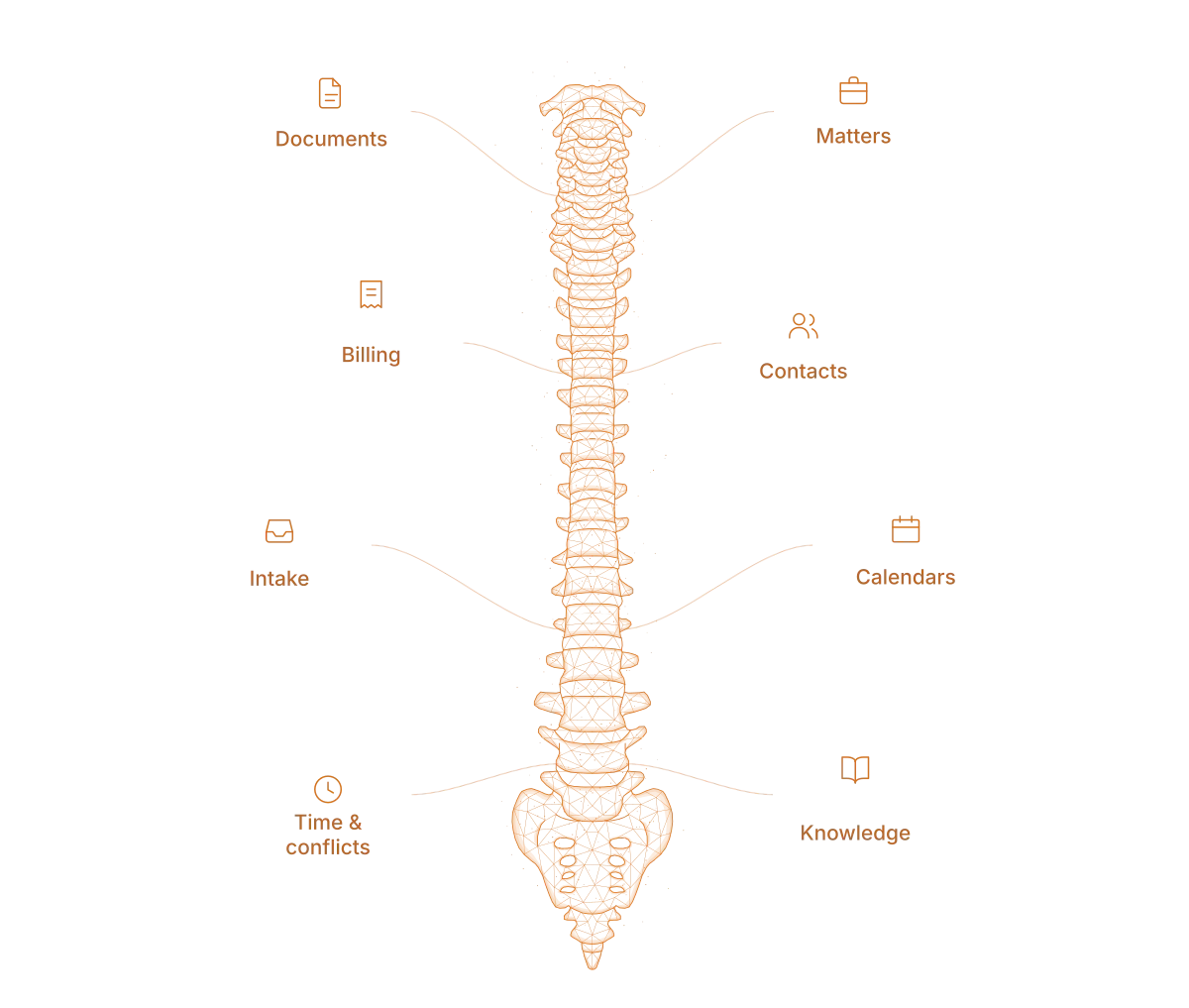
Documents live in one system. Matters, contacts, calendars, billing, intake, and knowledge live in others. Each new automation becomes another point-to-point integration, and each AI experiment creates a new path to information the firm is responsible for protecting.
Backbone Legal creates a stable layer between those systems and the people, applications, and agents permitted to use them. Instead of giving an assistant broad access, the firm exposes named resources and narrowly defined actions with validation, scope, and review built around the workflow.
The enablement method
We begin with the firm’s real systems and operating responsibilities, then define the narrowest useful digital contract around each approved action.
Identify systems, information owners, authoritative sources, data classes, existing APIs, and approval points before exposing a tool.
Build versioned adapters around supported APIs and carefully bounded integration paths without replacing the systems of record.
Bind each resource and tool to identity, authorization, input validation, matter scope, evidence, and the firm’s review requirements.
Deliver an approved catalog to selected assistants and workflows, beginning read-only where practical and expanding deliberately.
The control model
Know the person, workload, or agent making the request without treating authentication as blanket permission.
Carry the scope that makes a legal workflow meaningful, including ethical walls and purpose limitations.
Let the system that owns the record enforce the final decision, including revocation and unavailable-by-default behavior.
Retain bounded operational evidence for review while keeping privileged content out of broad telemetry.
Who does what
The firm decides, this service exposes and binds, and the system that owns the record still makes the call.
| Dimension | The firm | Backbone Legal | System of record |
|---|---|---|---|
| Who may act | Names the people, workloads, and agents permitted to act. | Binds every request to one of those named identities. | Accepts or refuses the identity it is handed. |
| What may be reached | Approves each resource and action before it is exposed. | Publishes only the approved set as typed contracts. | Holds the records and applies its own permissions. |
| Matter scope | Defines ethical walls and purpose limitations. | Carries that scope on every call it makes. | Applies the scope to what it returns. |
| The final decision | Sets the policy the decision follows. | Never overrides a refusal or re-issues a revoked grant. | Makes the final allow or deny, including revocation. |
| Evidence | Decides what must be retained and reviewed. | Records bounded operational evidence of each call. | Keeps its own audit trail of the underlying change. |
Firm-branded by design
The planned white-label application will use each firm’s identity, domain, brand, approved capabilities, and local policy. bbnlgl-web is the public service site; the later bbnlgl-app will be the separate firm-facing product.
Questions firms ask first
No. Backbone Legal provides technology implementation and integration services. It does not give legal, ethics, or compliance advice, and it does not supervise the practice of law.
No. Those stay the systems of record. Backbone Legal builds a governed interface in front of the APIs they already expose, so the firm keeps one authoritative source for each record.
Whatever the firm decides it may never do. That decision is made before any tool ships, written into the tool contract, and enforced by the system that owns the record rather than by the assistant.
One bounded workflow, named system owners, and an explicit list of actions that stay out of scope. Where practical the first release is read-only, and write access is added deliberately.
Backbone Legal is in formation. What exists today is the enablement method and the design work behind it. Capabilities described on this site are design commitments, not shipped guarantees.
Snyder Tech operates it. The planned firm-facing application is designed to carry the firm’s own name, domain, and brand while the governed foundation stays shared.
Build the first governed capability
Backbone Legal is in formation. Initial engagements should begin with a bounded firm workflow, named system owners, and an explicit decision about what an agent may never do.
Backbone Legal provides technology implementation and integration services. It is not a law firm and does not provide legal, ethics, or compliance advice.